

My Qamis Expert Guide
Four Gulf countries, four distinct fashion styles. Collars, cuts, and details: learn how to recognize them at a glance and choose the one that suits your style and the occasion.
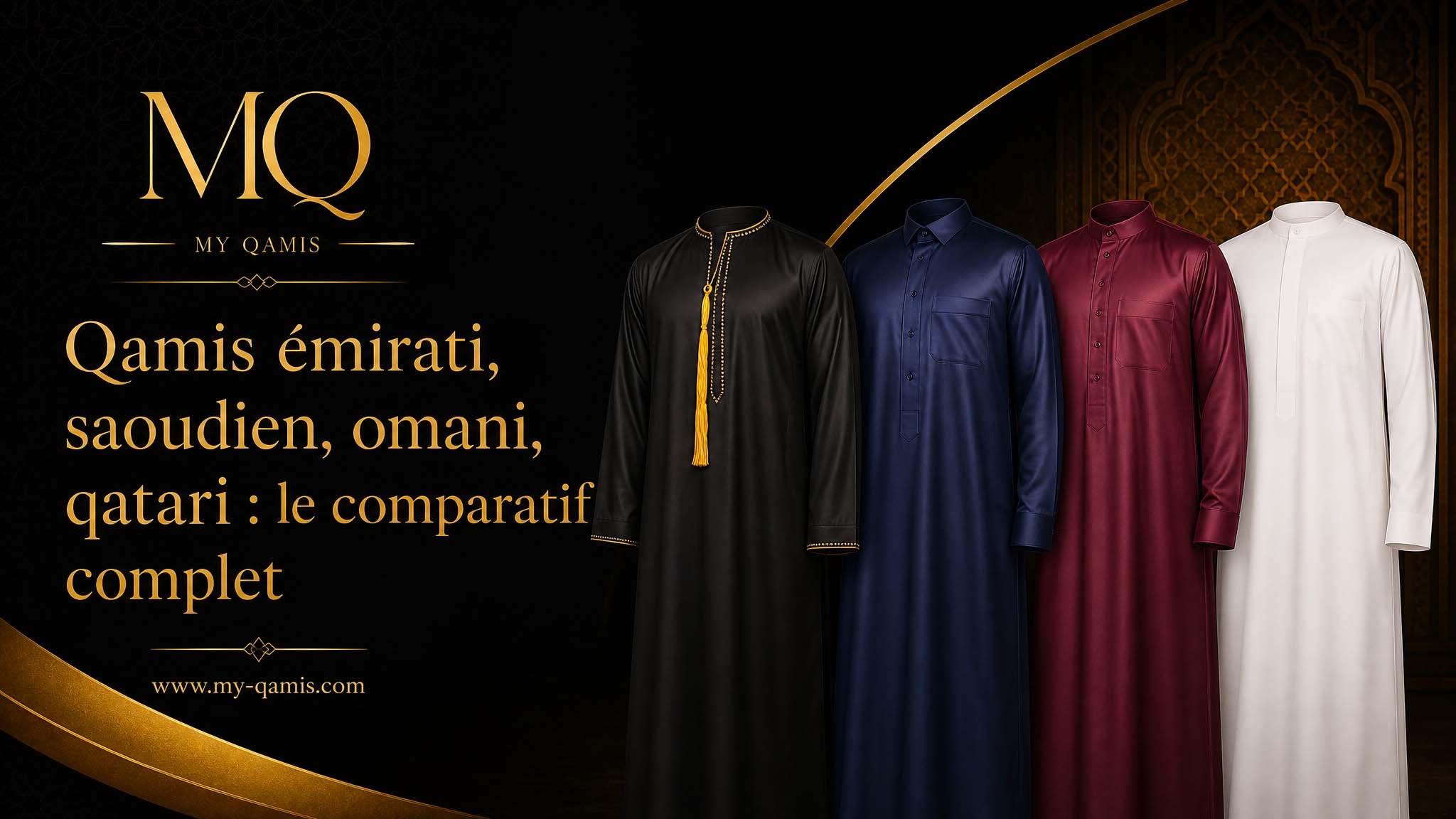
At first glance, all Gulf qamis look alike: a long tunic, often white, that falls to the ankles. And yet, someone from Muscat can instantly recognize a Riyadh-style cut, and an Emirati can spot a Qatari collar in a second. It all comes down to the details of the tailoring: the shape of the neckline, whether or not there’s a drawstring, and the finish of the cuffs.
At My Qamis, we work with these four styles every day: we receive them, inspect them, photograph them, and answer questions every week from customers who are torn between two models. This guide compiles the information we explain most often, to help you make an informed choice—and to wear your qamis with an understanding of its history.
The Emirati qamis (kandura): Dubai’s understated elegance
In the United Arab Emirates, they don't say "qamis" but kandura. This is the most minimalist style of the four: no collar, a simple round neckline, no visible buttons, and no chest pocket. Its signature feature is the tarboucha : a long braided cord that hangs down from the neckline, which Emiratis traditionally like to scent with oud essence.
The cut is straight, with a slight curve at the bust, designed to stay crisp even in intense heat. This is the style we recommend for anyone who wants a distinguished look without any frills: our selection of Emirati qamis faithfully reflects these codes.
Distinguishing Features
The Saudi qamis (thobe): the structured standard
Called thobe In Saudi Arabia, this is the most common style among Muslim men worldwide—and the one that most closely resembles a “shirt.” It can be recognized by its col, usually fastened with two buttons, with a button placket extending across the bust. Another detail that few people notice: its fitted sleeves finished like shirt cuffs, sometimes designed to accommodate cufflinks. A breast pocket often completes the look.
The silhouette is straight, almost architectural: it’s the most formal cut of the four, suitable for both a formal occasion and a business meeting. Our collection of Saudi qamis is, in fact, the most widely available item in the store, with or without a collar, depending on your preference.
The Omani qamis (dishdasha): Embroidery as a Legacy
In the Sultanate of Oman, the dishdasha has its own distinct identity. Like the Emirati kandura, it does not have a turned-down collar: it has a round neckline. But it differs from the kandura in that it embroidery, featuring intricate detailing around the neckline and the lace-up closure, which is sometimes echoed on the back of the garment. Her tarboucha is shorter than the Emirati version: a small tassel that hangs down at the side, traditionally soaked in perfume.
Made from soft, flowing fabrics, the Omani qamis is the choice for those who want to stand out with style: understated from a distance, intricately crafted up close.
The Qatari qamis: a tailor's precision
Qatar shares Saudi Arabia’s penchant for collars and clean lines, but Doha’s tailors pay close attention to the subtle details that make all the difference: a slightly more pointed collar, redesigned cuffs, and a tapered breast pocket. The fit is tailored, designed for a flawless drape and a suit-like look—without actually being one.
This is the model we recommend for anyone who loves the Saudi style but is looking for a more contemporary look: discover our Qatari qamis so you can form your own opinion.
The 4 cuts at a glance
Emirati
Collarless • long tarboucha • no embellishments • the epitome of understated elegance
Saudi
Two-button collar • shirt cuffs • breast pocket • the most formal and most common style
Omani
Embroidered neckline • scented tassel on the side • flowing fabric • the most meticulously crafted in every detail
Qatari
Tapered collar • slim fit • tailored details • the most contemporary of the four
Which one should you choose depending on the occasion?
For everyday wear and prayer, Emirati and Omani attire offer the greatest freedom of movement and remarkable comfort, especially when made of lightweight fabric. For Fridays, important occasions, or interviews, Saudi and Qatari styles provide the structure of formal attire while remaining true to tradition.
For special occasions—Eid, receptions, ceremonies—it all comes down to the fabric and finish: an embroidered Omani outfit or a Saudi outfit made of fine fabric will make a splash. And if you’re specifically looking for an exceptional outfit for a special day, our selection wedding qamis brings together our finest pieces.
Our expert advice: If this is your first qamis, start with a white or beige Saudi-style one—it’s the most versatile cut. Your second purchase is the perfect time to try an Emirati kandura or an Omani dishdasha and make a style statement.
FAQ – How to Identify and Choose a Gulf-Style Qamis
What is the purpose of the tarboucha on an Emirati qamis?
This braided cord is primarily decorative, but Emirati tradition gives it a refined use: it is soaked in a few drops of oud essence to subtly scent an outfit throughout the day.
Kandura, thobe, dishdasha: Are they the same garment?
These are three regional names for the same type of tunic: kandura in the United Arab Emirates, thobe (or thawb) in Saudi Arabia, and dishdasha in Oman, Qatar, and Kuwait. The differences lie in the specific cut and finishing details unique to each country.
Can you wear a Saudi qamis with cufflinks?
Yes, that’s actually one of its traditional touches: some Saudi designs feature cuffs modeled after those of a shirt, with buttonholes for cufflinks. It’s the perfect detail for a ceremony.
Are these styles suitable for all body types?
Yes, but each style flatters the figure differently: fitted cuts (Qatari, Saudi) define the silhouette, while flowing cuts (Omani) are particularly well-suited for those with a robust build or those who prefer a more relaxed fit. In any case, the qamis should remain loose-fitting and end above the ankles.
Now that you know how to recognize them, all that's left is to choose yours
From the UAE, Saudi Arabia, Oman, or Qatar: the four Gulf Cups await you, handpicked and vetted by our team.
Browse all our qamis